Where Vision Meets Legacy: The Five-Decade Blueprint of Architect Jeremias Tala Cruz

In the landscape of Philippine architecture, 50 years is more than a milestone; it is a timeline of the nation’s own urban evolution. For Architect Jeremias Tala Cruz, this half-century journey has been defined by a unique ability to bridge the gap between high-level international innovation and the essential needs of the Filipino home. From his early days in government service starting in 1972 to leading his firm, JTCruz and Partners, Cruz has remained a steadfast figure in shaping both social housing and modern commercial landmarks. His career reflects a deep commitment to large-scale development and public welfare, fueled by a rigorous academic foundation from Manuel L. Quezon University and a program with Ateneo de Manila University.
A pivotal chapter of this journey was written in 1981 when Cruz was awarded a scholarship from the Ministry of Human Settlements to study in the Netherlands. He attended the Bouwcentrum International Education (BIE)—now known as the Institute for Housing Studies (IHS) at Erasmus University—a global center of excellence that later received the UN-Habitat Scroll of Honor Award. Cruz was part of a historic cohort that served as the final group of graduates under the BIE name before its rebranding in 1982. The program was famously rigorous, featuring a 6 AM to 6 PM schedule that demanded total immersion in urban management and housing finance. Despite the workload, the experience allowed Cruz to exchange best practices with representatives from 12 countries, including the first batch of graduates from mainland China.

While in Rotterdam, Cruz became fascinated by the Dutch modular housing system, which utilized standardized components to reduce costs and empower homeowners through “self-help” improvements. Determined to apply these lessons locally, his final research paper proposed a modular redesign for Barangay Escopa in Quezon City. His vision for the community focused on infrastructure realignment, such as widening narrow roads, and upgrading essential drainage and sewer systems. Showing a profound pride in local craftsmanship, Cruz even brought physical samples of Philippine indigenous materials to share with his international classmates, advocating for them as sustainable alternatives to conventional construction.
Upon returning to the Philippines, Cruz applied this global training to developments that have since become part of the national fabric. His early work included the Tondo Foreshore Urban Renewal Project, a landmark effort in government-led housing. He also worked on the Ecological Technology and Livelihood Community Center (ECOTECH) in Sudlon, Lahug, Cebu City — a space designed to empower communities through sustainable technology and livelihood opportunities. In private practice, his portfolio expanded significantly to include the master planning of Entertainment City Manila for PAGCOR (2010), the design of Treston International College in BGC, and the Trace Aquatic Center in Los Baños—the celebrated venue for the 2005 SEA Games. Even as recently as 2023, he remained active with the completion of the Philippine Bible Society Building and the JB Packaging Factory. Arch. Cruz worked also with the Department of Public Work and Highways for the Mount Pinatubo Rehabilitation Project. He designed numerous church projects across Luzon and the Visayas — a calling deeply rooted in his being as a pastor’s son. Each structure stands as a heartfelt offering, his way of giving back to the Lord and faithfully serving the communities that shaped him.
Beyond the drawing board, Architect Cruz has served as a representative for the Philippines in the Asian Network of Major Cities (ANMC) and remains a pillar of the United Architects of the Philippines and the Rotary Club of Makati Central. Today, his focus includes mentoring the next generation of builders, ensuring that his legacy is not just recorded in stone and glass, but in the values of excellence and national pride he passes on to the architects of tomorrow. Architect Jeremias Tala Cruz stands as a testament to the power of a “global-local” approach—using world-class education to build a more resilient and inclusive Philippines.
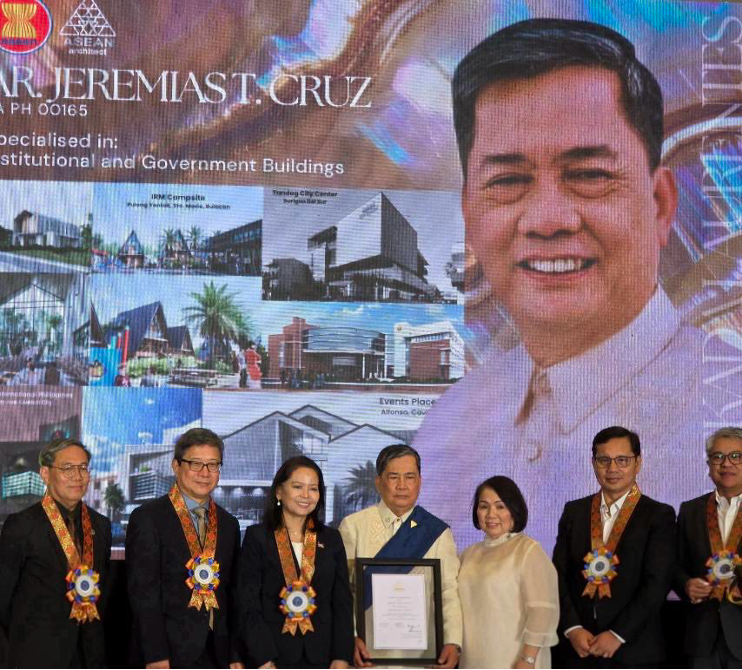
He has officially been conferred as an ASEAN Architect — one of only 178 Filipino architects to receive this prestigious distinction. This recognition allows him to practice and collaborate across ASEAN member countries, a testament to his competence, credibility, and contribution to the profession beyond our borders. It’s not just a personal achievement — it’s a recognition that brings pride to the Philippines and showcases the world-class talent of Filipino architects.